
Culture & Arts
Gaza: Long History of Wars and Defiance

by: Dr. Saeb Shaath
Gaza is one of the world’s oldest living cities. It is a city held to be of
major strategic importance. It was the only overland route between Africa and
Asia, which led Egypt to establish, in 3500 B.C., the citadel of Tell Sakan on
the banks of the Wadi Ghazzeh, some 12km from the modern city.
In the second millennia B.C., the Egyptians lost control of the city to the “Hyksos”, who expanded Gaza nearer to the sea front and built “Tell Al-Ajjul”. Hyksos people marched southward and captured the Great Egyptian Empire, about 1650 B.C.
They lasted around 100 years, before the Egyptian Army chased them out to the outskirts of Gaza. History informs us that the Egyptian then failed to crack
Gaza and retreated. Some 200 years later Gaza once again fell under the
domination of Egypt, an event marked in history as the conquest by Thutmose III on April 25, 1468 B.C.Gaza’s history has been shaped by its strategic location; in 734 B.C., the Assyrian Empire took complete control of Gaza. The Persian Empire in 539 B.C. expanded and annexed Gaza. In Gaza there is the ancient Greek city of Antidon dated to around 520 B.C., a port and settlement four kilometers from the Gaza city. In 332 B.C., Alexander the Great besieged Gaza, the last city to resist his design, for the control of the ancient world. Most of the old Babylonian domain, including Egypt, swiftly fell into Alexander’s hands.
Gaza dared to resist; a siege of two months followed by a ruin as complete as that of Tyre. The defenders, mostly local Arabs, fought to death, the women and children were taken captive. In 145 B.C. Gaza was conquered by Jonathan the Hasmonean (brother of Judah the Maccabee) who destroyed the suburbs of Gaza by fire. The Jewish King Alexander Jannaeus, after a siege of a year, brought destruction and massacres around 96 B.C. Neither Alexander the Great’s bloody conquest in 332 B.C. nor the brutal one by Alexander Janneus in 96 B.C. could vanquish Gaza who endured and rose again.
Around 50 B.C. Gaza became magnificent and so luxurious under the Romans.
Gaza would reach the peak of civilization; its exports in the 5th century A.D.
(during the Byzantine Empire) reached as far as England, Ireland and Geneva,
Gaza’s schools graduated leading theologians such as Barsanuphius, John of Gaza
and Mark the Deacon, whose writings profoundly influenced Christianity at its
early stages. According to the Jewish Encyclopedia, famous Gazan Jews included
the medieval liturgical poet Israel Najara, who is buried in Gaza’s local
cemetery, the Sabbatean Prophet Nathan of Gaza as well as Rabbi Abraham Azulai
who lived in Gaza in 1619. It was there that he wrote “Hesed le-Avraham”, the
book for which he is remembered.
The arrival of Islam in 637 A.D. would not change Gaza’s unique character.
Gaza remained a central crossroad. From the 8th century it sheltered the most
highly celebrated school of law in all of Islam, founded by Muhammad Al-Shafi.
The Crusaders under Baldwin I fought hard the Arab armies to control Gaza. In
the 1170 the Crusaders lost Gaza to Saladin.
Gaza became a prosperous city under the Mameluks — between the 13th and 16th
century. It was “A city so rich in trees it looks like a cloth of brocade spread
out upon the land,” wrote the 14th century Syrian scholar Al-Dimashqi. In 1516,
at the battle of Khan Yaunis, Gaza’s major southern town, Turkish forces under
the Grand Vizier Sinan Pasha defeated the Mameluks and Gaza fell under Turkish
control. In 1660, Hussein Pasha made Gaza the capital of Palestine. Napoleon
captured the Gaza city In February 1799, but when his forces entered the city
terrible plague engulfed them and forced Napoleon to retreat from Gaza. In 1832
Mohammad Ali made Gaza part of Egypt. Soon it became part of the Ottoman Empire
who fought the British three battles in defense of Gaza. The Ottomans lost it to
the British in the third battle of Gaza on Nov. 7, 1917 during World War I.
Sir Archibald Murray who led the first and the second battle of Gaza in
1916-1917 was dismissed and replaced by “the Bull”, Gen. Edmund Allenby, who
deceived the defenders by attacking Beersheba and then besieging Gaza. Gaza fell
and Allenby’s road to Jerusalem opened up.
Israel captured Gaza in the 1967 war. On Sept. 12, 2005, the Israeli Cabinet
formally declared an end to the military rule of Gaza; the IDF dismantled the
settlements and retreated behind the walls and electric fences. It was another
astonishing reminder of Gaza’s history and defiance.
The name Gaza means “strength and prevalence”; many layers of civilization
lie beneath its busy streets.
To uncover part of the ancient history of Gaza visit the Israel Museum, or
the private collections of the IDF (Israeli Defense Forces) generals who have
Gaza’s history on display in their villas. When we ride “Salh El Deen” (Saladin
road), which connect Gaza’s cities towns and villages, we are riding a road that
had been crossed by the greatest leaders, generals, Assyrians, Persians,
prophets, Pharaohs, Alexander the Great, the Crusaders, Napoleon Bonaparte, the
Turks, the British, even American presidents and chiefs of the CIA.
Gaza is still with us on planet earth and tells us: Armies have come and
armies have gone and ancient Gaza has endured and risen repeatedly. Villains
failed to send it in orbit to mar or sink it in the Mediterranean Sea; there is
a lesson to be learned.
Gaza once again honored its past by defeating the IDF who is armed by the
most sophisticated American war machines. The IDF retreated and sealed Gaza by
massive walls, electric and electronic fences. The IDF’s companies continued
sucking Gaza’s water out, and they are selling it back to the Gazans! Aren’t
they so smart? Nothing gets in or out without the IDF approval. Any goods in or
out have to go through security examination. That by itself is a unique process
since it destroys most of the goods, but who dares to object? Apart from the
high taxes, their service to the little Palestinian producers is to keep the
fresh produce (mainly vegetables, fruits and flowers) in the checkpoints for
weeks.
The large Israel companies come to the scene, they take what Western
supermarket chains need, and sell it for a very nice price; for fresh mint or
flat leaf parsley we pay one British pound or two US dollars, for a small little
bag of it. How much do you suppose Israel’s fat cats pay the little farmer in
Palestine, for that bag, around two cents, that is if he is lucky to sell in the
first place?
That is the happy scenario, the alternative is what happening now in Gaza:
Utter devastation. Israeli military actions since 2000, according to the Israeli
civil rights group B’Tselem, have killed four times as many civilians and eight
times as many children as the number of Israelis killed by Palestinian
violence.
Israeli factories got special production lines for the Palestinians; God
knows why? Since they can consume only what the IDF allows them to, they are
easy money for greedy capitalists in Israel.
As all of us watched recently on CNN, BBC and Aljazeera news networks, Gaza
is being subjected to a new style of holocaust. What the Gazans have to counter
the IDF’s state-of-the art high-tech weapons with? They have their right to
resist, and they improvise in making their primitive missiles. After all, they
are imprisoned by the IDF.
Gazans are denied the necessities of existence. Why? Don’t we campaign for
animal protection? Don’t we argue with the Japanese over whaling, don’t we pass
laws against foxhunting? Why then ignore what is happening to the millions of
refugees from Palestine? They are under attack on daily basis, for demanding the
implantations of the UN resolutions that definitely granted them the right to
return to their homes. The irony is that the same resolutions gave birth to the
State of Israel!
— Dr. Saeb Shaath is a writer, thinker , public speaker , Middle
Eastern affairs expert, and a former diplomat. He is the co-founder of Irish Map
(Medical Aid for Palestine).


Culture & Arts
Over 43 million join funeral ceremonies for Martyr Leader Imam Ali Khamenei in Iran, Iraq
Fra Hughes, reporting back From Iran, as he attending the funeral service in Mashhad for martyred Leader Imam Ayatollah Ali Khamenei .

Fra Hughes, reporting back From Iran, as he attending the funeral service in Mashhad for martyred Leader Imam Ayatollah Ali Khamenei .
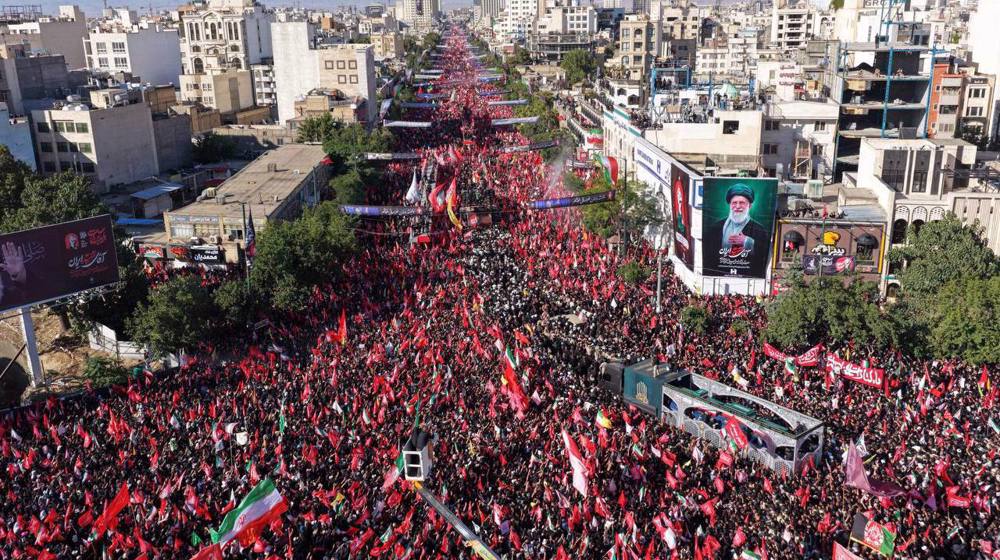
Tens of millions of Iranians and devotees from across the world turned the funeral ceremonies for the martyred Leader of the Islamic Revolution Ayatollah Seyyed Ali Khamenei, into the largest procession the world has ever witnessed, according to a report.
The six-day grand farewell and burial rites for the revered Leader were held across five cities — Tehran, Qom, Najaf, Karbala, and Mashhad — drawing massive, passionate crowds that defied all previous records, the Fars News Agency reported.
The ceremonies included three days in Tehran, two days of public mourning at the Grand Mosalla and one day of the main funeral procession, with each of the other cities hosting a full day of tributes. Many mourners traveled between cities, multiplying the scale of participation and creating a continuous wave of devotion.
Official estimates, compiled from multiple independent field and government sources, confirm that between 41 and 43 million people took part in the historic events.
These figures are based on a rigorous combination of data including public transport passenger records to and from ceremony sites, active mobile phone signals in key areas such as the Mosalla and main procession routes, average individual attendance duration of approximately two and a half hours, detailed crowd density calculations along Tehran’s procession paths, physical area measurements from Jamkaran Mosque to the Holy Shrine in Qom, and the route from the airport to the Imam Reza Holy Shrine in Mashhad.
The endless sea of mourners, who had gathered since early morning, accompanied the vehicle carrying the blessed bodies, transforming the streets of Mashhad into a scene of unparalleled grandeur and devotion.
The sheer scale of the gathering defied description. From the moment the funeral vehicle entered Imam Reza Street, it was completely surrounded by waves of mourners who had traveled from every corner of Iran, all united in grief and determination.
Their tear-streaked faces and fervent chants filled the air, creating an atmosphere that observers described as one of the most remarkable displays of national unity in recent history.
Iraqi authorities, through the Prime Minister’s Office, separately verified the presence of around 10 million mourners in Najaf and Karbala, providing an important independent pillar for the overall calculation.
Even when applying the most conservative methodologies, Iranian officials and relevant authorities emphasize that this monumental event has surpassed every comparable gathering of the past century.
It stands without doubt as the single largest funeral procession in recorded history, a powerful and everlasting testament to the deep love and unwavering allegiance of the Iranian people and the broader Islamic Ummah for their martyred Leader.
The Leader and members of his family were martyred in a terrorist attack on February 28, carried out by the United States and the Zionist regime against the leader’s residence.
Among those martyred were new Leader Ayatollah Seyyed Mojtaba Khamenei’s wife, the late leader’s son-in-law; a daughter of the late leader and his 14-month-old granddaughter.
The funeral ceremonies began last Friday, with tributes from political officials from over 45 countries and scholars from more than 90 nations. This was followed by farewell ceremonies at Tehran’s Mosalla over the weekend, where millions paid their respects.
Watch Fra Hughes, reporting back From Iran, as he attending the funeral service in Mashhad for martyred Leader Imam Ayatollah Ali Khamenei :
https://vm.tiktok.com/ZNREVSqqW
Culture & Arts
Sha’ath: Resistance axis to grow stronger after Ayatollah Khamenei.
Resistance axis to grow stronger after Ayatollah Khamenei

Thursday, 09 July 2026
An interview with, West Asia political expert Saeb Shaath discusses why massive participation in funeral processions held in Iraq for the martyred Leader of the Islamic Revolution Ayatollah Seyyed Ali Khamenei, goes beyond symbolic mourning, arguing that it reflects growing regional solidarity with Iran, shifting political dynamics in West Asia, and the enduring influence of Ayatollah Khamenei on the regional Axis of Resistance.
He also examines how Ayatollah Khamenei’s leadership helped unite diverse resistance movements around a common anti-imperialist agenda and what this legacy could mean for the future of the region.
Culture & Arts
Saeb Sha’ath: Large funeral turnout strengthened legacy of Iran’s martyred Leader
Saeb Sha’ath, asserted that the assassination had strengthened, rather than weakened, the late leader’s legacy.

Saeb Shaath, an author and political commentator, described the funeral procession for Iran’s martyred Leader, Ayatollah Seyed Ali Khamenei, as a demonstration of public unity and international support.
He argued that the massive turnout reflected the Iranian people’s resilience in the face of external pressure. Shaath said the participation of delegations from more than 100 countries, along with the large crowds in Tehran, underscored the growing support for Iran and the broader resistance movement. He also asserted that the assassination had strengthened, rather than weakened, the late leader’s legacy.

‘Yemenis said it very clear, a blockade will be faced by blockade’: Sha’ath

‘Saudis Arabia is not respecting its neighbours’: Commentator

Over 43 million join funeral ceremonies for Martyr Leader Imam Ali Khamenei in Iran, Iraq

Sha’ath: Resistance axis to grow stronger after Ayatollah Khamenei.

Saeb Sha’ath: Large funeral turnout strengthened legacy of Iran’s martyred Leader

One thousand days into the Zionist entity’s Genocide against the Palestinian people

Che’s triumphal return to Wall Street

رحلة السفر من غزة الى مصر

‘Israel’ Hijacking of Freedom Wave flotilla “Violent and Dangerous”, Activists beaten.

Palestine Ambassador to Ireland, ‘we support the Moyle District Council’s proposal to twin with Gaza City’.

Gamal Abdel Nasser, on the Muslim Brotherhood in Egypt

غزة آخر قلاع المجد

Iran’s ‘logical path’ to saving JCPOA

US president-elect Joe Biden and the Middle East

Are the French officials declaring open war on Islam?

UN ends the arms embargo on Iran

The USs theft of the Syrian crude oil

Analysing Lebanon’s multiple crises
-
Articles15 years ago
Che’s triumphal return to Wall Street
-
 Featured8 years ago
رحلة السفر من غزة الى مصر
-
News15 years ago
‘Israel’ Hijacking of Freedom Wave flotilla “Violent and Dangerous”, Activists beaten.
-
Featured15 years ago
Palestine Ambassador to Ireland, ‘we support the Moyle District Council’s proposal to twin with Gaza City’.
-
Culture & Arts14 years ago
Gamal Abdel Nasser, on the Muslim Brotherhood in Egypt
-
المقالات و الاخبار العربية12 years ago
غزة آخر قلاع المجد
-
 Culture & Arts15 years ago
No Negotiations with Apartheid ‘Israel’ – Let it Self-Destruct!
-
 Articles15 years ago
Confessions of 40 Turkish intelligence officers captured in Syria