
News
Revolutionaries recapture Tahrir Square

- Revolutionaries recapture Tahrir Square
Cairo… SaebPress/Alahram
By Yassin Gaber , Monday 21 Nov 2011
Security forces are expelled from the square by anti-SCAF protesters following two days of battles that many are calling the ’19th and 20th days’ of Egypt’s ongoing revolution
Following a deadly standoff in Cairo’s Tahrir Square at sunset, thousands of protesters regained their ground, successfully expelling the military police and soldiers – dressed in riot gear and wielding bludgeons and electroshock weapons – who stood before rows of Central Security Forces (CSF) firing barrage after barrage of tear gas. The streets of downtown Cairo were filled with fleeing protesters, weaving their way through burning trees and thick clouds of the toxic gas.
When the square was finally reclaimed, at least three protesters had been reported killed, with a fourth death later reported from a makeshift field hospital.
Tahrir’s thousands remained in the iconic square throughout Sunday. Fatigued protesters stood their ground, as CSF personnel battled to shore up their position around Egypt’s Cabinet offices and the reviled interior ministry.
A cold peace reigned on Shiekh Rehan Street for most of the day, where the American University in Cairo’s campus lies off of Qasr El-Aini Street. On the adjacent Mohamed Mahmoud Street, however, a hard-fought battle has continued to rage, with waves of protesters being battered back by endless salvoes of tear gas canisters.
Despite the difficulties, however, protesters have continued to march down the overturned blacktop and torn-up pavement, loudly repeating a single refrain in reference to the country’s de factor ruler: “The people demand the ouster of the field marshal [Mohammed Hussein Tantawi]!”
Although numerous political forces have maintained a presence in the square – including the Revolution Youth Coalition, of which the April 6 youth movement is a part, the National Front for Justice and Democracy and the “No to Military Trials” campaign, among others – and while Islamists turned out in force on Saturday night but were conspicuously absent on Sunday, today’s melee was marked by a monolithic, faction-less stand against CSF forces and plain-clothed police.
Several protesters standing at the frontlines were quick to stress their lack of affiliation with any particular political party or group, noting that today’s demonstration was not a political rally.
Weary protesters, many having stayed in Tahrir from the previous evening, expressed their fury over the violent crackdown and the Saturday morning attack on activists injured in the January uprising. Revolutionary demands were drowned out amid the thick smoke and the roar of protesters chanting against the ruling Supreme Council of the Armed Forces (SCAF) and its head, Tantawi.
Amid the palpable rage directed at the army and the ruling military council, any talk of elections or constitutions was all but inaudible if not completely absent. As of press time, the square’s political forces – now two days into the latest violent turn of events – were only beginning the process of formulating their respective statements.
Field hospitals along Mohamed Mahmoud Street, meanwhile, continue to treat an endless stream of injured and traumatised protesters.
“In the past three or four hours, roughly 300 cases have been admitted to the field hospital,” said Ayman Abo Zied, an activist/medic currently treating the wounded. “Of these, roughly 100 – coming five or six at a time – suffered the debilitating effects of tear gas.”
“The CSF’s use of tear gas is as it was in the past – fired at head level,” he added. “The rest of the injuries have been due to buckshot and rubber bullets being fired at chest and head level as well.”
A medical student, Abo Zied was denied his final certificate after taking a political stand deemed “subversive” and taking part in the ongoing revolution. Within the last two days, he himself has sustained a buckshot injury to his jaw, while being struck in the left hand by a rubber bullet.
According to some protesters, the main field hospital itself fell under attack at one point by security personnel.
Another medic at the scene said that buckshot and rubber bullet injuries appeared to increase as the day progressed. Motorcycles were widely used to transport casualties, meanwhile, with many protesters refusing to use ambulances – which seldom ventured into the square – out of fear they would fall into the hands of the CSF.
“Protesters flatly refuse to use ambulances,” said Basel Magdy, another doctor at the scene. “But in very serious cases, the first hospital they’re sent to is Mounira Hospital – not Qasr El-Aini.”
Abo Zied noted the difficulties associated with documenting the numerous injuries, given the violence and chaos that has rocked the area over the last two days.
SaebPress
Source: Alahram


Featured
‘Saudis Arabia is not respecting its neighbours’: Commentator
Yemen will enter a new stage to fully reclaim its rights, Saudi Arabia will find itself in a major strategic deadlock and will bear high costs for its aggression.

Commenting to PressTV on Saudi Arabia’s attack on Sana’a International Airport, author and commentator Saeb Shaath said ”Saudi Arabia’s actions destroy neighbours’ trust and destabilize the region”.
Yemen’s Foreign Ministry in Sana’a has condemned Saudi Arabia’s attack on Sana’a International Airport, saying that the strike marks the end of the truce and the beginning of a new phase of war.
In a statement on Monday, the Ministry declared that Yemen will enter a new stage to fully reclaim its rights, warning that Saudi Arabia will find itself in a major strategic deadlock and will bear high costs for its aggression.
Separately, the spokesman for the Yemeni Armed Forces, Brigadier General Yahya Saree, stated that “the Saudi aggression will not go unpunished,” adding, “The Saudi enemy has ended the de-escalation phase, and must bear responsibility for all potential consequences.”
The Yemeni Ministry of Transport announced in a statement that “Saudi Arabia’s bombardment of Sana’a airport and violation of the Yemeni airspace signifies the Riyadh regime’s insistence, with Americans’ and Zionists’ push, to continue the siege.”
On March 26, 2015, Saudi Arabia and its Arab allies initiated a blockade on Yemen, marking the beginning of a comprehensive war, backed with military, political, and logistical assistance from the United States and other Western countries.
The war has led to the deaths of tens of thousands of people in Yemen, while failing to achieve its primary goal of reinstating the previous government that was aligned with Riyadh.
Amid a power struggle, the government fled the country, leading Yemen’s popular resistance movement, Ansarullah, to take charge of state affairs.
After a delicate ceasefire brokered by the UN in 2022, multiple rounds of significant attacks were launched against Yemen by the United States, Britain, and the Israeli regime.
The assaults aimed to weaken Sana’a’s ability to conduct solidarity strikes against Israeli targets, which were being conducted in response to Tel Aviv’s genocidal actions in the Gaza Strip.
Culture & Arts
Over 43 million join funeral ceremonies for Martyr Leader Imam Ali Khamenei in Iran, Iraq
Fra Hughes, reporting back From Iran, as he attending the funeral service in Mashhad for martyred Leader Imam Ayatollah Ali Khamenei .

Fra Hughes, reporting back From Iran, as he attending the funeral service in Mashhad for martyred Leader Imam Ayatollah Ali Khamenei .
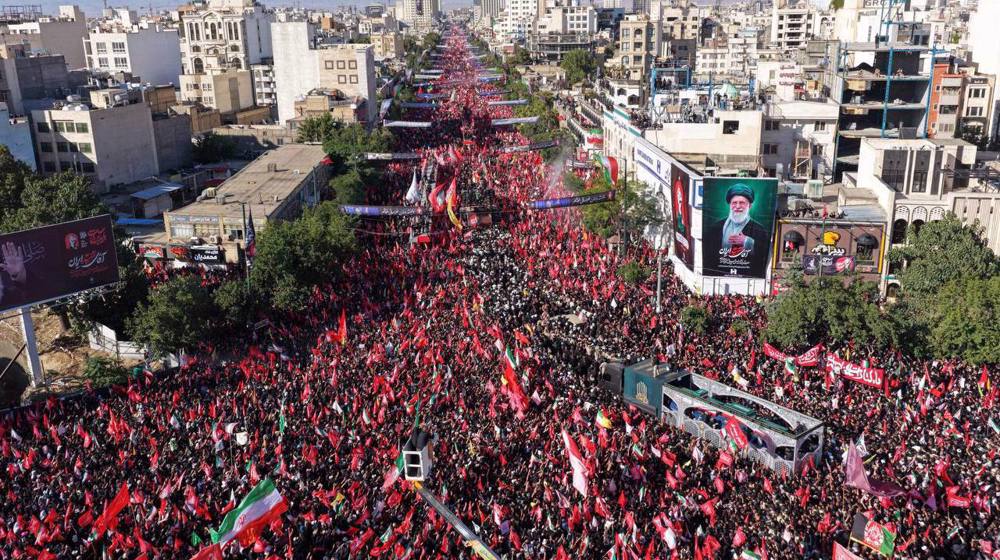
Tens of millions of Iranians and devotees from across the world turned the funeral ceremonies for the martyred Leader of the Islamic Revolution Ayatollah Seyyed Ali Khamenei, into the largest procession the world has ever witnessed, according to a report.
The six-day grand farewell and burial rites for the revered Leader were held across five cities — Tehran, Qom, Najaf, Karbala, and Mashhad — drawing massive, passionate crowds that defied all previous records, the Fars News Agency reported.
The ceremonies included three days in Tehran, two days of public mourning at the Grand Mosalla and one day of the main funeral procession, with each of the other cities hosting a full day of tributes. Many mourners traveled between cities, multiplying the scale of participation and creating a continuous wave of devotion.
Official estimates, compiled from multiple independent field and government sources, confirm that between 41 and 43 million people took part in the historic events.
These figures are based on a rigorous combination of data including public transport passenger records to and from ceremony sites, active mobile phone signals in key areas such as the Mosalla and main procession routes, average individual attendance duration of approximately two and a half hours, detailed crowd density calculations along Tehran’s procession paths, physical area measurements from Jamkaran Mosque to the Holy Shrine in Qom, and the route from the airport to the Imam Reza Holy Shrine in Mashhad.
The endless sea of mourners, who had gathered since early morning, accompanied the vehicle carrying the blessed bodies, transforming the streets of Mashhad into a scene of unparalleled grandeur and devotion.
The sheer scale of the gathering defied description. From the moment the funeral vehicle entered Imam Reza Street, it was completely surrounded by waves of mourners who had traveled from every corner of Iran, all united in grief and determination.
Their tear-streaked faces and fervent chants filled the air, creating an atmosphere that observers described as one of the most remarkable displays of national unity in recent history.
Iraqi authorities, through the Prime Minister’s Office, separately verified the presence of around 10 million mourners in Najaf and Karbala, providing an important independent pillar for the overall calculation.
Even when applying the most conservative methodologies, Iranian officials and relevant authorities emphasize that this monumental event has surpassed every comparable gathering of the past century.
It stands without doubt as the single largest funeral procession in recorded history, a powerful and everlasting testament to the deep love and unwavering allegiance of the Iranian people and the broader Islamic Ummah for their martyred Leader.
The Leader and members of his family were martyred in a terrorist attack on February 28, carried out by the United States and the Zionist regime against the leader’s residence.
Among those martyred were new Leader Ayatollah Seyyed Mojtaba Khamenei’s wife, the late leader’s son-in-law; a daughter of the late leader and his 14-month-old granddaughter.
The funeral ceremonies began last Friday, with tributes from political officials from over 45 countries and scholars from more than 90 nations. This was followed by farewell ceremonies at Tehran’s Mosalla over the weekend, where millions paid their respects.
Watch Fra Hughes, reporting back From Iran, as he attending the funeral service in Mashhad for martyred Leader Imam Ayatollah Ali Khamenei :
https://vm.tiktok.com/ZNREVSqqW
Culture & Arts
Sha’ath: Resistance axis to grow stronger after Ayatollah Khamenei.
Resistance axis to grow stronger after Ayatollah Khamenei

Thursday, 09 July 2026
An interview with, West Asia political expert Saeb Shaath discusses why massive participation in funeral processions held in Iraq for the martyred Leader of the Islamic Revolution Ayatollah Seyyed Ali Khamenei, goes beyond symbolic mourning, arguing that it reflects growing regional solidarity with Iran, shifting political dynamics in West Asia, and the enduring influence of Ayatollah Khamenei on the regional Axis of Resistance.
He also examines how Ayatollah Khamenei’s leadership helped unite diverse resistance movements around a common anti-imperialist agenda and what this legacy could mean for the future of the region.

‘Yemenis said it very clear, a blockade will be faced by blockade’: Sha’ath

‘Saudis Arabia is not respecting its neighbours’: Commentator

Over 43 million join funeral ceremonies for Martyr Leader Imam Ali Khamenei in Iran, Iraq

Sha’ath: Resistance axis to grow stronger after Ayatollah Khamenei.

Saeb Sha’ath: Large funeral turnout strengthened legacy of Iran’s martyred Leader

One thousand days into the Zionist entity’s Genocide against the Palestinian people

Che’s triumphal return to Wall Street

رحلة السفر من غزة الى مصر

‘Israel’ Hijacking of Freedom Wave flotilla “Violent and Dangerous”, Activists beaten.

Palestine Ambassador to Ireland, ‘we support the Moyle District Council’s proposal to twin with Gaza City’.

Gamal Abdel Nasser, on the Muslim Brotherhood in Egypt

غزة آخر قلاع المجد

Iran’s ‘logical path’ to saving JCPOA

US president-elect Joe Biden and the Middle East

Are the French officials declaring open war on Islam?

UN ends the arms embargo on Iran

The USs theft of the Syrian crude oil

Analysing Lebanon’s multiple crises
-
Articles15 years ago
Che’s triumphal return to Wall Street
-
 Featured8 years ago
رحلة السفر من غزة الى مصر
-
News15 years ago
‘Israel’ Hijacking of Freedom Wave flotilla “Violent and Dangerous”, Activists beaten.
-
Featured15 years ago
Palestine Ambassador to Ireland, ‘we support the Moyle District Council’s proposal to twin with Gaza City’.
-
Culture & Arts14 years ago
Gamal Abdel Nasser, on the Muslim Brotherhood in Egypt
-
المقالات و الاخبار العربية12 years ago
غزة آخر قلاع المجد
-
 Culture & Arts15 years ago
No Negotiations with Apartheid ‘Israel’ – Let it Self-Destruct!
-
 Articles15 years ago
Confessions of 40 Turkish intelligence officers captured in Syria