
Culture & Arts
Celebrating Christopher Hitchens’s life and Hanukkah
Maccabean revolt soon became exorbitantly corrupt, vicious, and divided, and encouraged the Roman annexation of Judea. Had it not been for this no-less imperial event, we would never have had to hear of Jesus of Nazareth or his sect—which was a plagiarism from fundamentalist Judaism—and the Jewish people would never have been accused of being deicidal “Christ killers.” Thus, to celebrate Hanukkah is to celebrate not just the triumph of tribal Jewish backwardness but also the accidental birth of Judaism’s bastard child in the shape of Christianity.

- Christopher Hitchens
SaebPress….The brilliant writer Christopher Hitchens who died last week, questioned as many other writers and thinkers did the idealistic narrative of the Maccabees. In his best-selling ‘God is not Great’, Hitchens examines Hanukkah and all it stands for. SaebPress celebrating Christopher Hitchens’s life, in doing so we republish Christopher’s excellent piece on Hanukkah.
Bah, Hanukkah
The holiday celebrates the triumph of tribal Jewish backwardness.
By Christopher Hitchens
High on the list of idiotic commonplace expressions is the old maxim that “it is better to light a candle than to curse the darkness.” How do such fatuous pieces of folk wisdom ever get started on their careers of glib quotation? Of course it would be preferable to light a candle than to complain about the darkness. You would only be bitching about the darkness if you didn’t have a candle to begin with. Talk about a false antithesis. But at this time of year, any holy foolishness is permitted. And so we have a semiofficial celebration of Hanukkah, complete with menorah, to celebrate not the ignition of a light but the imposition of theocratic darkness.
Jewish orthodoxy possesses the interesting feature of naming and combating the idea of the apikoros or “Epicurean”—the intellectual renegade who prefers Athens to Jerusalem and the schools of philosophy to the grim old routines of the Torah. About a century and a half before the alleged birth of the supposed Jesus of Nazareth (another event that receives semiofficial recognition at this time of the year), the Greek or Epicurean style had begun to gain immense ground among the Jews of Syria and Palestine. The Seleucid Empire, an inheritance of Alexander the Great—Alexander still being a popular name among Jews—had weaned many people away from the sacrifices, the circumcisions, the belief in a special relationship with God, and the other reactionary manifestations of an ancient and cruel faith. I quote Rabbi Michael Lerner, an allegedly liberal spokesman for Judaism who nonetheless knows what he hates:
Along with Greek science and military prowess came a whole culture that celebrated beauty both in art and in the human body, presented the world with the triumph of rational thought in the works of Plato and Aristotle, and rejoiced in the complexities of life presented in the theater of Aeschylus, Euripides and Aristophanes.
But away with all that, says Lerner. Let us instead celebrate the Maccabean peasants who wanted to destroy Hellenism and restore what he actually calls “oldtime religion.” His excuse for preferring fundamentalist thuggery to secularism and philosophy is that Hellenism was “imperialistic,” but the Hasmonean regime that resulted from the Maccabean revolt soon became exorbitantly corrupt, vicious, and divided, and encouraged the Roman annexation of Judea. Had it not been for this no-less imperial event, we would never have had to hear of Jesus of Nazareth or his sect—which was a plagiarism from fundamentalist Judaism—and the Jewish people would never have been accused of being deicidal “Christ killers.” Thus, to celebrate Hanukkah is to celebrate not just the triumph of tribal Jewish backwardness but also the accidental birth of Judaism’s bastard child in the shape of Christianity. You might think that masochism could do no more. Except that it always can. Without the precedents of Orthodox Judaism and Roman Christianity, on which it is based and from which it is borrowed, there would be no Islam, either. Every Jew who honors the Hanukkah holiday because it gives his child an excuse to mingle the dreidel with the Christmas tree and the sleigh (neither of these absurd symbols having the least thing to do with Palestine two millenniums past) is celebrating the making of a series of rods for his own back. And this is not just a disaster for the Jews. When the fanatics of Palestine won that victory, and when Judaism repudiated Athens for Jerusalem, the development of the whole of humanity was terribly retarded.
And, of course and as ever, one stands aghast at the pathetic scale of the supposed “miracle.” As a consequence of the successful Maccabean revolt against Hellenism, so it is said, a puddle of olive oil that should have lasted only for one day managed to burn for eight days. Wow! Certain proof, not just of an Almighty, but of an Almighty with a special fondness for fundamentalists. Epicurus and Democritus had brilliantly discovered that the world was made up of atoms, but who cares about a mere fact like that when there is miraculous oil to be goggled at by credulous peasants?
We are about to have the annual culture war about the display of cribs, mangers, conifers, and other symbols on public land. Most of this argument is phony and tawdry and secondhand and has nothing whatever to do with “faith” as its protagonists understand it. The burning of a Yule log or the display of a Scandinavian tree is nothing more than paganism and the observance of a winter solstice; it makes no more acknowledgment of the Christian religion than I do. The fierce partisanship of the holly bush and mistletoe believers convicts them of nothing more than ignorance and simple-mindedness. They would have been just as pious under the reign of the Druids or the Vikings, and just as much attached to their bucolic icons. Everybody knows, furthermore, that there was no moving star in the east, that Quirinius was not the governor of Syria in the time of King Herod, that no worldwide tax census was conducted in that period of the rule of Augustus, and that no “stable” is mentioned even in any of the mutually contradictory books of the New Testament. So, to put a star on top of a pine tree or to arrange various farm animals around a crib is to be as accurate and inventive as that Japanese department store that, as urban legend has it, did its best to emulate the Christmas spirit by displaying a red-and-white bearded Santa snugly nailed to a crucifix.
This is childish stuff and if only for that reason should obviously not receive any public endorsement or financing. The display of the menorah at this season, however, has a precise meaning and is an explicit celebration of the original victory of bloody-minded faith over enlightenment and reason. As such it is a direct negation of the First Amendment and it is time for the secularists and the civil libertarians to find the courage to say so.
Christopher Hitchens (1949-2011) was a columnist for Vanity Fair and the author, most recently, of Arguably, a collection of essays

Culture & Arts
Over 43 million join funeral ceremonies for Martyr Leader Imam Ali Khamenei in Iran, Iraq
Fra Hughes, reporting back From Iran, as he attending the funeral service in Mashhad for martyred Leader Imam Ayatollah Ali Khamenei .

Fra Hughes, reporting back From Iran, as he attending the funeral service in Mashhad for martyred Leader Imam Ayatollah Ali Khamenei .
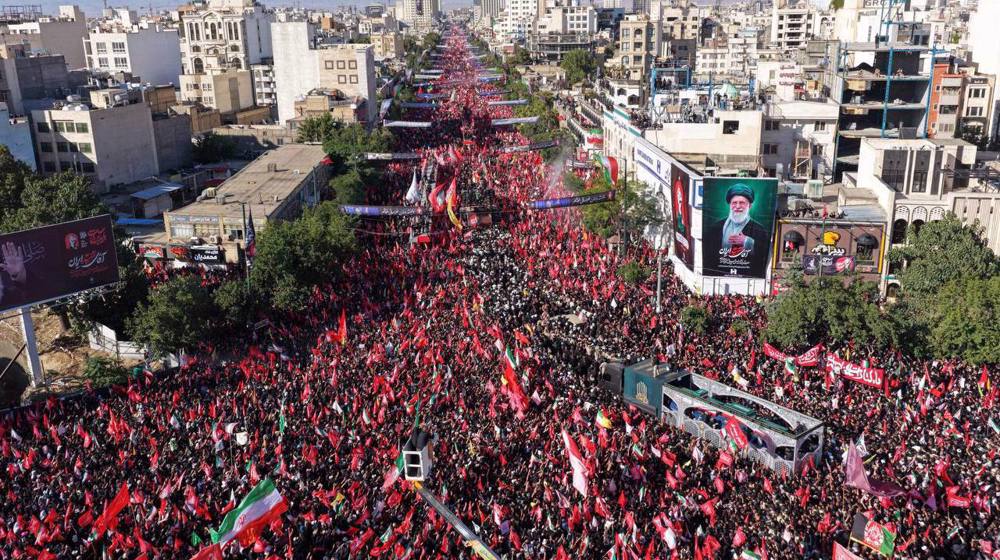
Tens of millions of Iranians and devotees from across the world turned the funeral ceremonies for the martyred Leader of the Islamic Revolution Ayatollah Seyyed Ali Khamenei, into the largest procession the world has ever witnessed, according to a report.
The six-day grand farewell and burial rites for the revered Leader were held across five cities — Tehran, Qom, Najaf, Karbala, and Mashhad — drawing massive, passionate crowds that defied all previous records, the Fars News Agency reported.
The ceremonies included three days in Tehran, two days of public mourning at the Grand Mosalla and one day of the main funeral procession, with each of the other cities hosting a full day of tributes. Many mourners traveled between cities, multiplying the scale of participation and creating a continuous wave of devotion.
Official estimates, compiled from multiple independent field and government sources, confirm that between 41 and 43 million people took part in the historic events.
These figures are based on a rigorous combination of data including public transport passenger records to and from ceremony sites, active mobile phone signals in key areas such as the Mosalla and main procession routes, average individual attendance duration of approximately two and a half hours, detailed crowd density calculations along Tehran’s procession paths, physical area measurements from Jamkaran Mosque to the Holy Shrine in Qom, and the route from the airport to the Imam Reza Holy Shrine in Mashhad.
The endless sea of mourners, who had gathered since early morning, accompanied the vehicle carrying the blessed bodies, transforming the streets of Mashhad into a scene of unparalleled grandeur and devotion.
The sheer scale of the gathering defied description. From the moment the funeral vehicle entered Imam Reza Street, it was completely surrounded by waves of mourners who had traveled from every corner of Iran, all united in grief and determination.
Their tear-streaked faces and fervent chants filled the air, creating an atmosphere that observers described as one of the most remarkable displays of national unity in recent history.
Iraqi authorities, through the Prime Minister’s Office, separately verified the presence of around 10 million mourners in Najaf and Karbala, providing an important independent pillar for the overall calculation.
Even when applying the most conservative methodologies, Iranian officials and relevant authorities emphasize that this monumental event has surpassed every comparable gathering of the past century.
It stands without doubt as the single largest funeral procession in recorded history, a powerful and everlasting testament to the deep love and unwavering allegiance of the Iranian people and the broader Islamic Ummah for their martyred Leader.
The Leader and members of his family were martyred in a terrorist attack on February 28, carried out by the United States and the Zionist regime against the leader’s residence.
Among those martyred were new Leader Ayatollah Seyyed Mojtaba Khamenei’s wife, the late leader’s son-in-law; a daughter of the late leader and his 14-month-old granddaughter.
The funeral ceremonies began last Friday, with tributes from political officials from over 45 countries and scholars from more than 90 nations. This was followed by farewell ceremonies at Tehran’s Mosalla over the weekend, where millions paid their respects.
Watch Fra Hughes, reporting back From Iran, as he attending the funeral service in Mashhad for martyred Leader Imam Ayatollah Ali Khamenei :
https://vm.tiktok.com/ZNREVSqqW
Culture & Arts
Sha’ath: Resistance axis to grow stronger after Ayatollah Khamenei.
Resistance axis to grow stronger after Ayatollah Khamenei

Thursday, 09 July 2026
An interview with, West Asia political expert Saeb Shaath discusses why massive participation in funeral processions held in Iraq for the martyred Leader of the Islamic Revolution Ayatollah Seyyed Ali Khamenei, goes beyond symbolic mourning, arguing that it reflects growing regional solidarity with Iran, shifting political dynamics in West Asia, and the enduring influence of Ayatollah Khamenei on the regional Axis of Resistance.
He also examines how Ayatollah Khamenei’s leadership helped unite diverse resistance movements around a common anti-imperialist agenda and what this legacy could mean for the future of the region.
Culture & Arts
Saeb Sha’ath: Large funeral turnout strengthened legacy of Iran’s martyred Leader
Saeb Sha’ath, asserted that the assassination had strengthened, rather than weakened, the late leader’s legacy.

Saeb Shaath, an author and political commentator, described the funeral procession for Iran’s martyred Leader, Ayatollah Seyed Ali Khamenei, as a demonstration of public unity and international support.
He argued that the massive turnout reflected the Iranian people’s resilience in the face of external pressure. Shaath said the participation of delegations from more than 100 countries, along with the large crowds in Tehran, underscored the growing support for Iran and the broader resistance movement. He also asserted that the assassination had strengthened, rather than weakened, the late leader’s legacy.

‘Yemenis said it very clear, a blockade will be faced by blockade’: Sha’ath

‘Saudis Arabia is not respecting its neighbours’: Commentator

Over 43 million join funeral ceremonies for Martyr Leader Imam Ali Khamenei in Iran, Iraq

Sha’ath: Resistance axis to grow stronger after Ayatollah Khamenei.

Saeb Sha’ath: Large funeral turnout strengthened legacy of Iran’s martyred Leader

One thousand days into the Zionist entity’s Genocide against the Palestinian people

Che’s triumphal return to Wall Street

رحلة السفر من غزة الى مصر

‘Israel’ Hijacking of Freedom Wave flotilla “Violent and Dangerous”, Activists beaten.

Palestine Ambassador to Ireland, ‘we support the Moyle District Council’s proposal to twin with Gaza City’.

Gamal Abdel Nasser, on the Muslim Brotherhood in Egypt

غزة آخر قلاع المجد

Iran’s ‘logical path’ to saving JCPOA

US president-elect Joe Biden and the Middle East

Are the French officials declaring open war on Islam?

UN ends the arms embargo on Iran

The USs theft of the Syrian crude oil

Analysing Lebanon’s multiple crises
-
Articles15 years ago
Che’s triumphal return to Wall Street
-
 Featured8 years ago
رحلة السفر من غزة الى مصر
-
News15 years ago
‘Israel’ Hijacking of Freedom Wave flotilla “Violent and Dangerous”, Activists beaten.
-
Featured15 years ago
Palestine Ambassador to Ireland, ‘we support the Moyle District Council’s proposal to twin with Gaza City’.
-
Culture & Arts14 years ago
Gamal Abdel Nasser, on the Muslim Brotherhood in Egypt
-
المقالات و الاخبار العربية12 years ago
غزة آخر قلاع المجد
-
 Culture & Arts15 years ago
No Negotiations with Apartheid ‘Israel’ – Let it Self-Destruct!
-
 Articles15 years ago
Confessions of 40 Turkish intelligence officers captured in Syria