
News
Criminal War on Gaza and Unprecedented Cyber-warfare targeting ‘Israel’

GAZA CITY (SaebPress) – ‘Israel’ has launched more than 130 aerial and sea attacks against the besieged Gaza Strip on Sunday.
“Surgical Strike, Precision Bombing…….If this generation believe that a bomb of some half ton of high explosives can be thrown at a heavily populated area and kill only those its intended to kill,
then our planet is fairly dumb. Just think about it…… Half a ton’’ commented Padraig Mc Shane a human rights activists from Ireland.
Eleven Palestinians, including four women and four children, were killed on Sunday afternoon when an ‘Israeli’ F-16 warplane targeted the al-Dalou family home in Gaza City.
Israeli forces continued to bombard the Gaza Strip on Sunday evening and targeting residential areas and dropping large bombs on Gaza’s homes. Today Sunday is the bloodiest day in the
war on Gaza so far resident in North Gaza said. .
The al-Karama Hospital in Gaza City and the European hospital in Khan Yunis sustained extensive damage from an airstrike.
‘Israeli’ F-16 warplane targeted the home of Sbeih family in al-Daraj neighbourhood of Gaza City.
A Palestinian man was the 25th fatality of the day when an ‘Israeli’ F-16 warplane targeted a building in western Gaza City.
Some 73 Palestinians have been killed and 682 wounded since ‘Israel’ launched Operation Pillar of Cloud on Wednesday.
The Palestinian resistance vowed to avenge what it described a massacre, and fired Fajr 5 missiles at Tel Aviv. Reuters news agency confirmed 2 loud explosions were heard in Tel Aviv
minutes after the resistance declaration, while an ‘Israeli ‘ military spokesperson said the missile was intercepted by the Iron Dome defence shield.
The al-Qassam Brigades said its fighters had also shelled Israeli military bases and an Israeli war ship in response to the attack on the al-Dalou family.
Palestinian resistance in Gaza have targeted an ‘Israeli’ attack helicopter in Beit Hanoun in northern Gaza.
Also Sunday, two men were killed in Nuseirat refugee camp, and another two men were killed in separate strikes on the Shujaiyya neighborhood of Gaza City.
‘Israe’l also hit al-Maghazl, al-Buriej and al-Shati refugee camps, killing three including a 9-year-old girl and an 18-month-old boy.
In northern Gaza, two toddlers and a 52-year-old woman were killed, a man and his teenage son were hit by a missile while driving their water tanker, another man was killed in southern Gaza at the same time.
War on Gaza, Surgical Strike targeting Gaza’s homes.
Meanwhile ‘Israeli’ Prime Minister Benjamin Netanyahu said he assured world leaders that Israel was doing its utmost to avoid causing civilian casualties in Gaza.
‘Israeli’ army prepare for an invasion of Gaza, tanks, artillery infantry and Military convoys massed in field encampments along the sandy, fenced-off border.
An ‘Israeli’ military spokesman confirmed that 544 rockets fired from Gaza have hit Israel since Wednesday, killing three civilians and wounding dozens, while 302 were intercepted.
Unprecedented Cyber-warfare over 50 million attacks targeted the ‘Israeli’ government websites
The ‘Israeli’ government has become a victim of cyber-warfare attacks since Operation Pillar of Defence began four days ago. On Saturday,
hacktivist group Anonymous launched a massive attack on over 700 Israeli websites.
Meanwhile the Palestinian resistance managed to hack into a database of ‘Israeli’ army officers and sent 1000’s of the messages to their phones to tell them that Gaza’s resistance is waiting on them.
The country’s finance minister has acknowledged the recent wave of attacks, saying the government is now waging a war on a “second front.”
Over the past four days, Israel has “deflected 44 million cyber-attacks on government websites,” Israeli Finance Minister Yuval Steinitz told AP.
Steinitz said the government has come up with a backup for “essential websites,” should they be taken down by hackers.
“This is an unprecedented attack, and our success has been greater than we anticipated,” he said


Featured
‘Saudis Arabia is not respecting its neighbours’: Commentator
Yemen will enter a new stage to fully reclaim its rights, Saudi Arabia will find itself in a major strategic deadlock and will bear high costs for its aggression.

Commenting to PressTV on Saudi Arabia’s attack on Sana’a International Airport, author and commentator Saeb Shaath said ”Saudi Arabia’s actions destroy neighbours’ trust and destabilize the region”.
Yemen’s Foreign Ministry in Sana’a has condemned Saudi Arabia’s attack on Sana’a International Airport, saying that the strike marks the end of the truce and the beginning of a new phase of war.
In a statement on Monday, the Ministry declared that Yemen will enter a new stage to fully reclaim its rights, warning that Saudi Arabia will find itself in a major strategic deadlock and will bear high costs for its aggression.
Separately, the spokesman for the Yemeni Armed Forces, Brigadier General Yahya Saree, stated that “the Saudi aggression will not go unpunished,” adding, “The Saudi enemy has ended the de-escalation phase, and must bear responsibility for all potential consequences.”
The Yemeni Ministry of Transport announced in a statement that “Saudi Arabia’s bombardment of Sana’a airport and violation of the Yemeni airspace signifies the Riyadh regime’s insistence, with Americans’ and Zionists’ push, to continue the siege.”
On March 26, 2015, Saudi Arabia and its Arab allies initiated a blockade on Yemen, marking the beginning of a comprehensive war, backed with military, political, and logistical assistance from the United States and other Western countries.
The war has led to the deaths of tens of thousands of people in Yemen, while failing to achieve its primary goal of reinstating the previous government that was aligned with Riyadh.
Amid a power struggle, the government fled the country, leading Yemen’s popular resistance movement, Ansarullah, to take charge of state affairs.
After a delicate ceasefire brokered by the UN in 2022, multiple rounds of significant attacks were launched against Yemen by the United States, Britain, and the Israeli regime.
The assaults aimed to weaken Sana’a’s ability to conduct solidarity strikes against Israeli targets, which were being conducted in response to Tel Aviv’s genocidal actions in the Gaza Strip.
Culture & Arts
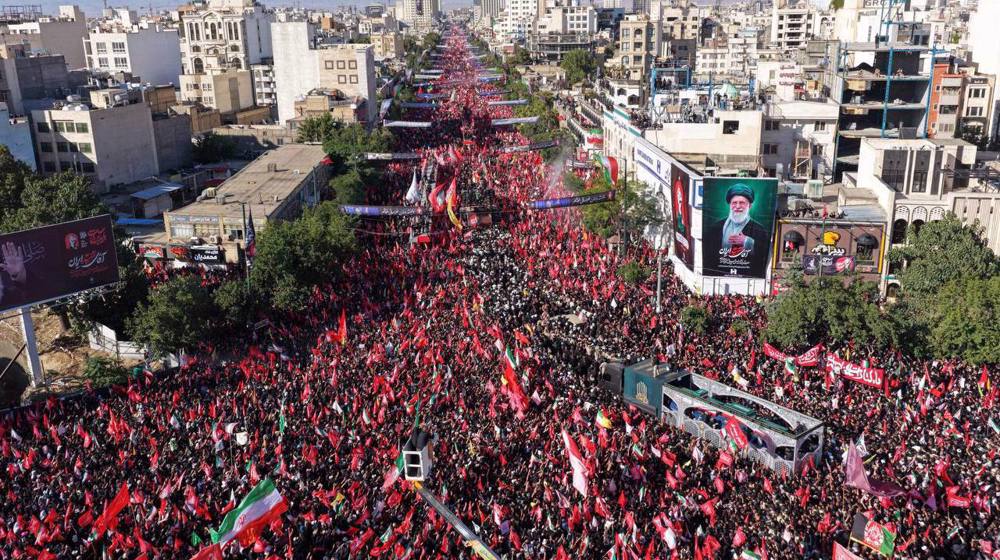
Over 43 million join funeral ceremonies for Martyr Leader Imam Ali Khamenei in Iran, Iraq
Fra Hughes, reporting back From Iran, as he attending the funeral service in Mashhad for martyred Leader Imam Ayatollah Ali Khamenei .

Fra Hughes, reporting back From Iran, as he attending the funeral service in Mashhad for martyred Leader Imam Ayatollah Ali Khamenei .
Tens of millions of Iranians and devotees from across the world turned the funeral ceremonies for the martyred Leader of the Islamic Revolution Ayatollah Seyyed Ali Khamenei, into the largest procession the world has ever witnessed, according to a report.
The six-day grand farewell and burial rites for the revered Leader were held across five cities — Tehran, Qom, Najaf, Karbala, and Mashhad — drawing massive, passionate crowds that defied all previous records, the Fars News Agency reported.
The ceremonies included three days in Tehran, two days of public mourning at the Grand Mosalla and one day of the main funeral procession, with each of the other cities hosting a full day of tributes. Many mourners traveled between cities, multiplying the scale of participation and creating a continuous wave of devotion.
Official estimates, compiled from multiple independent field and government sources, confirm that between 41 and 43 million people took part in the historic events.
These figures are based on a rigorous combination of data including public transport passenger records to and from ceremony sites, active mobile phone signals in key areas such as the Mosalla and main procession routes, average individual attendance duration of approximately two and a half hours, detailed crowd density calculations along Tehran’s procession paths, physical area measurements from Jamkaran Mosque to the Holy Shrine in Qom, and the route from the airport to the Imam Reza Holy Shrine in Mashhad.
The endless sea of mourners, who had gathered since early morning, accompanied the vehicle carrying the blessed bodies, transforming the streets of Mashhad into a scene of unparalleled grandeur and devotion.
The sheer scale of the gathering defied description. From the moment the funeral vehicle entered Imam Reza Street, it was completely surrounded by waves of mourners who had traveled from every corner of Iran, all united in grief and determination.
Their tear-streaked faces and fervent chants filled the air, creating an atmosphere that observers described as one of the most remarkable displays of national unity in recent history.
Iraqi authorities, through the Prime Minister’s Office, separately verified the presence of around 10 million mourners in Najaf and Karbala, providing an important independent pillar for the overall calculation.
Even when applying the most conservative methodologies, Iranian officials and relevant authorities emphasize that this monumental event has surpassed every comparable gathering of the past century.
It stands without doubt as the single largest funeral procession in recorded history, a powerful and everlasting testament to the deep love and unwavering allegiance of the Iranian people and the broader Islamic Ummah for their martyred Leader.
The Leader and members of his family were martyred in a terrorist attack on February 28, carried out by the United States and the Zionist regime against the leader’s residence.
Among those martyred were new Leader Ayatollah Seyyed Mojtaba Khamenei’s wife, the late leader’s son-in-law; a daughter of the late leader and his 14-month-old granddaughter.
The funeral ceremonies began last Friday, with tributes from political officials from over 45 countries and scholars from more than 90 nations. This was followed by farewell ceremonies at Tehran’s Mosalla over the weekend, where millions paid their respects.
Watch Fra Hughes, reporting back From Iran, as he attending the funeral service in Mashhad for martyred Leader Imam Ayatollah Ali Khamenei :
https://vm.tiktok.com/ZNREVSqqW
Culture & Arts
Sha’ath: Resistance axis to grow stronger after Ayatollah Khamenei.
Resistance axis to grow stronger after Ayatollah Khamenei

Thursday, 09 July 2026
An interview with, West Asia political expert Saeb Shaath discusses why massive participation in funeral processions held in Iraq for the martyred Leader of the Islamic Revolution Ayatollah Seyyed Ali Khamenei, goes beyond symbolic mourning, arguing that it reflects growing regional solidarity with Iran, shifting political dynamics in West Asia, and the enduring influence of Ayatollah Khamenei on the regional Axis of Resistance.
He also examines how Ayatollah Khamenei’s leadership helped unite diverse resistance movements around a common anti-imperialist agenda and what this legacy could mean for the future of the region.

‘Yemenis said it very clear, a blockade will be faced by blockade’: Sha’ath

‘Saudis Arabia is not respecting its neighbours’: Commentator

Over 43 million join funeral ceremonies for Martyr Leader Imam Ali Khamenei in Iran, Iraq

Sha’ath: Resistance axis to grow stronger after Ayatollah Khamenei.

Saeb Sha’ath: Large funeral turnout strengthened legacy of Iran’s martyred Leader

One thousand days into the Zionist entity’s Genocide against the Palestinian people

Che’s triumphal return to Wall Street

رحلة السفر من غزة الى مصر

‘Israel’ Hijacking of Freedom Wave flotilla “Violent and Dangerous”, Activists beaten.

Palestine Ambassador to Ireland, ‘we support the Moyle District Council’s proposal to twin with Gaza City’.

Gamal Abdel Nasser, on the Muslim Brotherhood in Egypt

غزة آخر قلاع المجد

Iran’s ‘logical path’ to saving JCPOA

US president-elect Joe Biden and the Middle East

Are the French officials declaring open war on Islam?

UN ends the arms embargo on Iran

The USs theft of the Syrian crude oil

Analysing Lebanon’s multiple crises
-
Articles15 years ago
Che’s triumphal return to Wall Street
-
 Featured8 years ago
رحلة السفر من غزة الى مصر
-
News15 years ago
‘Israel’ Hijacking of Freedom Wave flotilla “Violent and Dangerous”, Activists beaten.
-
Featured15 years ago
Palestine Ambassador to Ireland, ‘we support the Moyle District Council’s proposal to twin with Gaza City’.
-
Culture & Arts14 years ago
Gamal Abdel Nasser, on the Muslim Brotherhood in Egypt
-
المقالات و الاخبار العربية12 years ago
غزة آخر قلاع المجد
-
 Culture & Arts15 years ago
No Negotiations with Apartheid ‘Israel’ – Let it Self-Destruct!
-
 Articles15 years ago
Confessions of 40 Turkish intelligence officers captured in Syria