
Featured
Northern Ireland regional government in crisis
The North of Ireland after partition had an inbuilt pro-British unionist colonial population and through this inbuilt gerrymandered majority the Ulster Unionist Party ruled the North of Ireland from 1921 as a one-party state

SaebPress – Belfast
By Fra Hughes

The devolved regional assembly of Northern Ireland which sits at Stormont the building, previously housed the N Ireland government from 1922 to 1972 is in crisis.
The precipitation something as ordinary as a funeral something that happens every day all over the world but this was no ordinary funeral
This was the funeral of Bobby Storey a charismatic leader of the Irish Republican Army. An icon to generations of republicans and a man held in high esteem by colleagues and former comrades alike.
Storey was also credited with overseeing the appropriation of hundreds of classified secret police Special Branch files in March 2002 at their Headquarters in Castlereagh Police Station .
A close personal friend to Gerry Adams former leader of Sinn Fein an ex-prisoner and the man many believe masterminded the escape of 38 republicans from Long Kesh maximum security prison camp known as HMP The Maze on September 25, 1983, One of Europes most secure prisons and designed specifically to prevent communication between political prisoners

On December 15, 2014, the Northern Bank Headquarters based on Donegal Square West Belfast had 26.5 million pounds stolen. Accusations that Storey and the IRA were involved in the raid have never been proven
The anecdotes involving Mr Storey are too numerous to mention and many will probably never be told Known only to a few people who will probably carry them to their graves.
Mr Storey passed away shortly after having an unsuccessful lung transplant in Newcastle Upon Tyne England
He died on June 21 aged 64 and had served 20 years in prison on various charges connected to his membership and active participation in the IRA armed campaign for national liberation
Michelle O Neill is the deputy party leader of Sinn Fein and serves as Joint First Minister in the Northern Ireland Assembly
Since Ireland was partitioned by the British in 1921 we have had two governments on the island of Ireland one North and one South of the border.
The North of Ireland after partition had an inbuilt pro-British unionist colonial population and through this inbuilt gerrymandered majority the Ulster Unionist Party ruled the North of Ireland from 1921 as a one-party state
A Protestant Parliament and a Protestant State is a quote from Lord Craigavon in 1934.
The indigenous Catholic Irish absorbed into this new partitioned statelet were treated as second class citizens and viewed as an enemy by the new state.
After nearly 25 years of internal armed conflict in Northern Ireland from August 1969 to the IRA ceasefire June 1994, a new dispensation was then created and the people of Ireland North and Soth voted in favour of the Good Friday Agreement also known as the Belfast Agreement on April 10, 1998, and the IRA embraced politics as a method to obtain National Reunification over armed militant struggle and so the Peace Process was born
This was followed by a devolved government being elected and the IRA enter government at the old Parliamentary Building at Stormont.
The newly elected Assembly first sat on July 1 1998
Powers were re devolved to the Northern Assembly on December 2, 1999, having been suspended from 1972
This has been an uneasy marriage between two sets of political antagonists.
One one side the descendants of the colonial settlements of English and Scottish settlers who wish to maintain the link with the United Kingdom they are Unionists and then we have the indigenous Irish who wish to see the final removal of the British State occupation of Ireland with the national reunification of Ireland were all of the people of the island, unionist and nationalist republican and loyalist can decide on their future together without British governmental interference.
The outworking of this experiment is a forced Mandatory coalition delivering both political parties a veto on disputed legislation
The assembly has collapsed twice before
That last collapse was in January 2017 with the assembly only reforming after fresh elections on January 11 2020.
The COVID 19 pandemic has led to restrictive enforcement of legislation around funerals.
It limited the number in attendance to 10 close family relatives and until recently the cemeteries and crematoria were closed to the public.
With the Death of Mr Storey, an impasse has been reached.
Prior to COVID 19, Mr Storey would have received a full semi-state like funeral from his IRA comrades and the political Elite of Sinn Fein
Thousands would have attended from all over Ireland America Britain and Europe
His funeral would have been massive akin to the funerals of the IRA and INLA Hunger Strikers in 1981
However, the restrictive guidelines in place today because of COVID 19 allow for a maximum of 30 people to attend the funeral, socially distancing at between one and to metres.
At Mr Storey’s funeral, there were indeed 30 people walking behind the funeral cortege. There were also 120 in attendance at St Agnes requiem mass on the morning of the funeral
A guard of honour and the streets lined with former IRA comrades and Sinn Fein members from the church to the cemetery
Probably in excess of 1000-to 1800 people attended perhaps more with the streets lined with mourners many of whom were from Belfast showing their respect for a fallen hero
Now the Unionist members of the Assembly aided by some members of the Social Democratic Labour Party have called on the joint first minister Michelle ONeill deputy leader of Sinn Fein to stand aside from her position while Police carry out an investigation as to whether she and leading members of Sinn Fein, all elected members of both Parliaments on the island, are in breach of their own COVID 19 restrictions?
Sinn Fein has consistently claimed the funeral met all statutory regulations as to the number of mourners and social distancing
They claim they tried to mitigate the size of the crowd in attendance
To the other Assembly members, Sinn Fein are not above the law and must lead by example during a Pandemic and they have called for ONeill to resign
The Assembly is a combative pugilistic type arena and many outside see the calls for resignation as nothing more than political opportunism from unionists and optics for the gallery
Having fallen twice before, should the assembly collapse again it could be strike three and your out!


Featured
‘Yemenis said it very clear, a blockade will be faced by blockade’: Sha’ath

Saeb Shaath, author and commentator, says Yemen’s control over the Bab al-Mandeb Strait has emerged as a major strategic challenge for Saudi Arabia and its Western allies, arguing that any disruption to the vital maritime corridor could have far-reaching consequences for global trade, energy markets, and regional security.
News / Interviews ‘Yemenis said it very clear, a blockade will be … | TikTok
He also discusses that Yemen’s deterrence capabilities have shifted the regional balance of power while increasing pressure on Riyadh to seek a political solution rather than military escalation.
Featured
‘Saudis Arabia is not respecting its neighbours’: Commentator
Yemen will enter a new stage to fully reclaim its rights, Saudi Arabia will find itself in a major strategic deadlock and will bear high costs for its aggression.

Commenting to PressTV on Saudi Arabia’s attack on Sana’a International Airport, author and commentator Saeb Shaath said ”Saudi Arabia’s actions destroy neighbours’ trust and destabilize the region”.
Yemen’s Foreign Ministry in Sana’a has condemned Saudi Arabia’s attack on Sana’a International Airport, saying that the strike marks the end of the truce and the beginning of a new phase of war.
In a statement on Monday, the Ministry declared that Yemen will enter a new stage to fully reclaim its rights, warning that Saudi Arabia will find itself in a major strategic deadlock and will bear high costs for its aggression.
Separately, the spokesman for the Yemeni Armed Forces, Brigadier General Yahya Saree, stated that “the Saudi aggression will not go unpunished,” adding, “The Saudi enemy has ended the de-escalation phase, and must bear responsibility for all potential consequences.”
The Yemeni Ministry of Transport announced in a statement that “Saudi Arabia’s bombardment of Sana’a airport and violation of the Yemeni airspace signifies the Riyadh regime’s insistence, with Americans’ and Zionists’ push, to continue the siege.”
On March 26, 2015, Saudi Arabia and its Arab allies initiated a blockade on Yemen, marking the beginning of a comprehensive war, backed with military, political, and logistical assistance from the United States and other Western countries.
The war has led to the deaths of tens of thousands of people in Yemen, while failing to achieve its primary goal of reinstating the previous government that was aligned with Riyadh.
Amid a power struggle, the government fled the country, leading Yemen’s popular resistance movement, Ansarullah, to take charge of state affairs.
After a delicate ceasefire brokered by the UN in 2022, multiple rounds of significant attacks were launched against Yemen by the United States, Britain, and the Israeli regime.
The assaults aimed to weaken Sana’a’s ability to conduct solidarity strikes against Israeli targets, which were being conducted in response to Tel Aviv’s genocidal actions in the Gaza Strip.
Culture & Arts
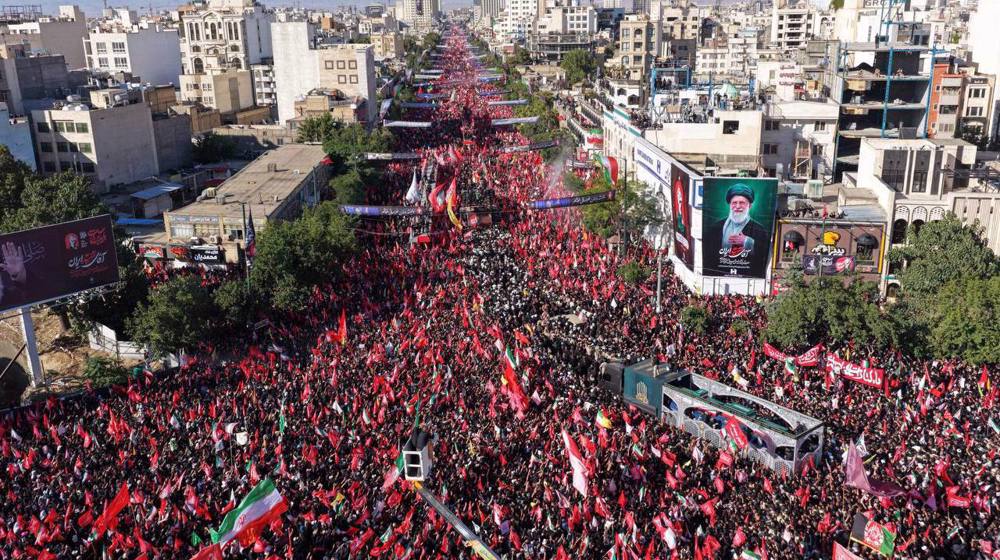
Over 43 million join funeral ceremonies for Martyr Leader Imam Ali Khamenei in Iran, Iraq
Fra Hughes, reporting back From Iran, as he attending the funeral service in Mashhad for martyred Leader Imam Ayatollah Ali Khamenei .

Fra Hughes, reporting back From Iran, as he attending the funeral service in Mashhad for martyred Leader Imam Ayatollah Ali Khamenei .
Tens of millions of Iranians and devotees from across the world turned the funeral ceremonies for the martyred Leader of the Islamic Revolution Ayatollah Seyyed Ali Khamenei, into the largest procession the world has ever witnessed, according to a report.
The six-day grand farewell and burial rites for the revered Leader were held across five cities — Tehran, Qom, Najaf, Karbala, and Mashhad — drawing massive, passionate crowds that defied all previous records, the Fars News Agency reported.
The ceremonies included three days in Tehran, two days of public mourning at the Grand Mosalla and one day of the main funeral procession, with each of the other cities hosting a full day of tributes. Many mourners traveled between cities, multiplying the scale of participation and creating a continuous wave of devotion.
Official estimates, compiled from multiple independent field and government sources, confirm that between 41 and 43 million people took part in the historic events.
These figures are based on a rigorous combination of data including public transport passenger records to and from ceremony sites, active mobile phone signals in key areas such as the Mosalla and main procession routes, average individual attendance duration of approximately two and a half hours, detailed crowd density calculations along Tehran’s procession paths, physical area measurements from Jamkaran Mosque to the Holy Shrine in Qom, and the route from the airport to the Imam Reza Holy Shrine in Mashhad.
The endless sea of mourners, who had gathered since early morning, accompanied the vehicle carrying the blessed bodies, transforming the streets of Mashhad into a scene of unparalleled grandeur and devotion.
The sheer scale of the gathering defied description. From the moment the funeral vehicle entered Imam Reza Street, it was completely surrounded by waves of mourners who had traveled from every corner of Iran, all united in grief and determination.
Their tear-streaked faces and fervent chants filled the air, creating an atmosphere that observers described as one of the most remarkable displays of national unity in recent history.
Iraqi authorities, through the Prime Minister’s Office, separately verified the presence of around 10 million mourners in Najaf and Karbala, providing an important independent pillar for the overall calculation.
Even when applying the most conservative methodologies, Iranian officials and relevant authorities emphasize that this monumental event has surpassed every comparable gathering of the past century.
It stands without doubt as the single largest funeral procession in recorded history, a powerful and everlasting testament to the deep love and unwavering allegiance of the Iranian people and the broader Islamic Ummah for their martyred Leader.
The Leader and members of his family were martyred in a terrorist attack on February 28, carried out by the United States and the Zionist regime against the leader’s residence.
Among those martyred were new Leader Ayatollah Seyyed Mojtaba Khamenei’s wife, the late leader’s son-in-law; a daughter of the late leader and his 14-month-old granddaughter.
The funeral ceremonies began last Friday, with tributes from political officials from over 45 countries and scholars from more than 90 nations. This was followed by farewell ceremonies at Tehran’s Mosalla over the weekend, where millions paid their respects.
Watch Fra Hughes, reporting back From Iran, as he attending the funeral service in Mashhad for martyred Leader Imam Ayatollah Ali Khamenei :
https://vm.tiktok.com/ZNREVSqqW

‘Yemenis said it very clear, a blockade will be faced by blockade’: Sha’ath

‘Saudis Arabia is not respecting its neighbours’: Commentator

Over 43 million join funeral ceremonies for Martyr Leader Imam Ali Khamenei in Iran, Iraq

Sha’ath: Resistance axis to grow stronger after Ayatollah Khamenei.

Saeb Sha’ath: Large funeral turnout strengthened legacy of Iran’s martyred Leader

One thousand days into the Zionist entity’s Genocide against the Palestinian people

Che’s triumphal return to Wall Street

رحلة السفر من غزة الى مصر

‘Israel’ Hijacking of Freedom Wave flotilla “Violent and Dangerous”, Activists beaten.

Palestine Ambassador to Ireland, ‘we support the Moyle District Council’s proposal to twin with Gaza City’.

Gamal Abdel Nasser, on the Muslim Brotherhood in Egypt

غزة آخر قلاع المجد

Iran’s ‘logical path’ to saving JCPOA

US president-elect Joe Biden and the Middle East

Are the French officials declaring open war on Islam?

UN ends the arms embargo on Iran

The USs theft of the Syrian crude oil

Analysing Lebanon’s multiple crises
-
Articles15 years ago
Che’s triumphal return to Wall Street
-
 Featured8 years ago
رحلة السفر من غزة الى مصر
-
News15 years ago
‘Israel’ Hijacking of Freedom Wave flotilla “Violent and Dangerous”, Activists beaten.
-
Featured15 years ago
Palestine Ambassador to Ireland, ‘we support the Moyle District Council’s proposal to twin with Gaza City’.
-
Culture & Arts14 years ago
Gamal Abdel Nasser, on the Muslim Brotherhood in Egypt
-
المقالات و الاخبار العربية12 years ago
غزة آخر قلاع المجد
-
 Culture & Arts15 years ago
No Negotiations with Apartheid ‘Israel’ – Let it Self-Destruct!
-
 Articles15 years ago
Confessions of 40 Turkish intelligence officers captured in Syria